
Why Bifold Barn Door Hardware Is the Smart Solution for Tight Spaces
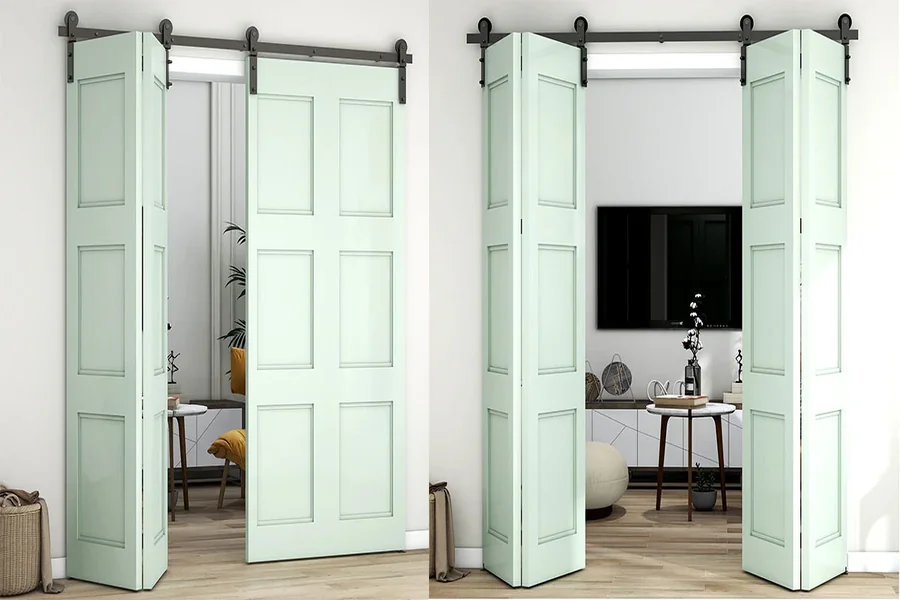
There’s a particular kind of frustration that comes with renovating a small room. You’ve got the layout figured out, the finishes chosen, and then you open the door and it swings straight into the vanity, or blocks the closet, or just eats half the usable floor space every time someone walks through. A standard swinging door needs clearance. In a small bathroom, a narrow hallway, or a laundry closet, that clearance often doesn’t exist.
Bifold barn door hardware solves this in a way that neither a traditional swinging door nor a standard sliding barn door can. It’s not the flashiest solution in the room — people tend to notice the door itself long before they notice the hardware — but it’s the hardware that makes the whole thing work, and choosing the wrong setup leads to a door that folds unevenly, jams at the pivot point, and gradually becomes one of those small daily annoyances you stop noticing only because you’ve made peace with it.
What Bifold Barn Door Hardware Actually Does Differently
A standard barn door slides along a single track on one plane. It needs clear wall space equal to at least the width of the door on one side of the opening so the door has somewhere to go when it’s open. In a tight hallway or a small room with adjoining walls close to the door frame, that wall space often isn’t there.
Bifold barn door hardware changes the geometry. Instead of one solid door sliding to one side, two door panels are connected at a central hinge, and both panels ride a top track. When the door opens, the panels fold against each other and stack in roughly half the space a single sliding door would need. A 36-inch opening that would require 36 inches of clear wall for a standard barn door might only need 18 to 20 inches with a bifold setup.
That’s a significant difference in a room where every inch counts.
The hardware is doing more work than in a standard sliding setup, because it’s managing both the sliding motion along the track and the folding motion at the pivot. The quality of the pivot hardware, the smoothness of the rollers, and the precision of the track alignment all matter more here than they would with a simpler door configuration.
The Components Worth Understanding Before You Buy
The Track
Bifold barn door track is similar in appearance to standard barn door track — a horizontal rail mounted above the door opening — but it needs to be properly rated for the combined weight of two door panels and engineered to handle the lateral forces that come from the folding motion. A track that flexes under load will cause the panels to bind at the pivot point, which is one of the more aggravating hardware failures to diagnose and fix after the fact.
Steel track is standard. Thickness matters: thinner track is more prone to flex, particularly on wider openings. For most residential applications with standard-weight doors, a 1/4-inch or thicker steel track is what you’re looking for.
Track length needs to account for the folded stack width plus adequate clearance at the ends for the roller hardware. Measure the opening width, calculate the folded panel depth (typically just over half the total door width, accounting for panel thickness), and add several inches of clearance on each end. Undershooting the track length is a surprisingly common mistake that leaves you with a door that can’t fully open.
The Pivot Hardware
This is where bifold setups diverge most from standard barn door hardware, and it’s where quality differences are most felt in daily use.
The pivot connects the two door panels and allows them to fold while the top roller travels along the track. A well-made pivot is smooth, has minimal play, and holds the panels in consistent alignment whether the door is open or closed. A cheap pivot develops slop over time — the panels start to sag unevenly, the door no longer closes flush, and the whole setup starts to look like it was installed by someone who gave up halfway through.
Pivot hardware comes in flush-mount and face-mount configurations. Flush-mount is cleaner visually because the hardware sits recessed into the door edge, but it requires routing or a router jig to install correctly. Face-mount bolts directly to the door face and is considerably easier to install, with only a minor visual trade-off. For most homeowners doing their own installation, face-mount is the practical choice.
The Floor Guide
A floor guide is a small piece of hardware that sits at the bottom of the door and keeps the panels tracking straight. On a bifold, it typically sits at the center fold point and prevents the bottom of the door from swinging out from the wall when the door is in motion.
Some bifold hardware kits include a floor guide; some don’t. If yours doesn’t, it’s worth buying one separately. A bifold door without a floor guide tends to drift at the bottom, and a heavy door drifting outward while it’s being opened or closed doesn’t feel great to use.
The Weight and Size Question
Bifold barn door hardware is available in weight ratings ranging from around 40 pounds per panel up to 100 pounds or more for heavy-duty commercial-grade systems. Getting the weight rating right matters.
Solid wood doors are heavy. A 36-inch solid hardwood panel at standard thickness can weigh 25 to 40 pounds on its own — so two panels means 50 to 80 pounds of door, before you add any glass inserts or decorative hardware. Hollow-core or MDF doors are considerably lighter, but they’re also more prone to flexing at the pivot point over time, which eventually causes the fold alignment to drift.
If you’re planning a door with glass panels — frosted glass for a bathroom, for instance, where you want some privacy but also borrowed light — factor in the glass weight carefully. Glass adds more than people expect, and an under-rated hardware kit is one of those choices that feels fine until it very suddenly doesn’t.
Where Bifold Barn Door Hardware Works Best
The obvious application is closets. A bifold barn door on a reach-in closet opening gives you full access to the interior without the door swinging into the room, and the sliding-folding motion is one most people find intuitive to use. Laundry closets are another strong application for the same reason — when the washer door and the closet door are competing for the same airspace, something has to give.
Bathrooms are worth thinking about carefully. A bifold barn door on a bathroom is a real space-saver, but the gap between door panels and between door and frame is less forgiving of noise and light than a swinging door with a proper latch and weather seal. It’s a trade-off, and whether it’s the right trade-off depends on the specific bathroom and who’s using it. A powder room off a living room is a different conversation than a main bathroom shared by people who’d like some acoustic privacy.
Home offices have become a surprisingly common application for bifold barn doors in the last several years. The ability to close off a workspace fully when not in use, without dedicating wall space to a swinging door or needing a full wall-width sliding track, fits well with a lot of home configurations.
Installation Realities
Bifold barn door hardware is more involved to install than standard barn door hardware. There are more components, the alignment tolerances are tighter, and getting the pivot hardware plumb and level makes a real difference to how smoothly the finished door operates.
The track needs to go into studs or a solid header board, same as any barn door installation. The additional forces from the folding motion make this even less negotiable than with a standard sliding door — a track that’s pulling away from the wall even slightly will show up immediately in how the pivot behaves.
Level matters more here than most DIY guides emphasize. If the track isn’t perfectly level, the door will drift toward the low end when open, which over time puts uneven stress on the pivot hardware and leads to premature wear.
Most bifold hardware kits include reasonably detailed installation instructions, and following them closely — rather than improvising based on how standard barn door hardware works — saves a lot of troubleshooting. The pivot hardware in particular tends to have specific adjustment procedures that aren’t obvious on first encounter but make a significant difference to the finished result.
Finish and Style
Bifold barn door hardware is available in the same finish options as standard hardware — matte black, brushed nickel, oil-rubbed bronze, satin brass — and the same principles apply. Match the hardware finish to the door style and the other metal finishes in the room, pick something that will age reasonably rather than just look good on day one, and don’t let the hardware fight with the door for attention.
The one additional consideration with bifold hardware is that the pivot point is visible from both sides. On a standard barn door the hardware is mostly seen from the front; on a bifold, anyone on either side of the door sees the pivot hardware. It’s worth choosing something you don’t mind looking at from both angles, not just from the main room side.
Getting bifold barn door hardware right takes a bit more care than a standard installation. But in a space where a swinging door or a full sliding door simply won’t work, it’s not really a luxury decision — it’s just the door that actually fits.